
Companies, which missed out on listing earlier, are giving it another shot but with significantly-reduced issue sizes. In the recent past, companies such as TVS Supply Chain Solutions, Suraj Estate Developers, and ESAF Small Finance Bank have re-filed their draft red herring prospectuses (DRHPs) with the Securities and Exchange Board of India (Sebi). This came after they slashed their issue sizes by 20-60 per cent.

'India has always been a bottom-up stock-picking market, and as growth recovers with higher liquidity, mid and small-caps always tend to outperform.'

The sharp jump in shares of Kalyan Jewellers (Kalyan) has surprised many on the Street; however, analysts believe more steam could be left in the stock as the Thrissur-based gold retailer pivots to a new asset-light network expansion model. Kalyan's stock has surged 62 per cent in the past month, even as the S&P BSE SmallCap Index has gained just 5 per cent. In its latest business update, the company said its consolidated sales grew more than consensus expectations at 31 per cent year-on-year, led by strong domestic sales regardless of the volatility in gold prices.

India's outward Foreign Direct Investment (FDI) nosedived to $11.12 billion in January-June (H1 2023) from $23.57 billion in the same period last year, indicative of the slowdown in the global economy, according to the Reserve Bank of India (RBI) data. The outward FDI expressed as the total financial commitment, has three components, namely equity, loan and guarantees. The sharp contraction in the commitments (outward FDI) was prominent in the April-June 2023 period.

The gauge for the performance of informational technology (IT) stocks soared nearly 5 per cent-most in nearly three years-as growth worries eased following a robust order book posted by bellwether Tata Consultancy Services (TCS). The Nifty IT index rose 4.5 per cent to close at 30,945. This was the biggest single-day gain since September 14, 2020. Industry titan TCS' shares rose 5 per cent to Rs 3,509.

Outward remittances under the Reserve Bank of India's (RBI) liberalised remittance scheme (LRS) rose in May 2023 to $2.88 billion as compared to $2.33 billion in April, mainly due to an uptick in travel spend. People in India spent close to $1.5 billion on international travel in May, against $1.10 billion in April.

Benefiting from higher credit off-take and loan repricing, listed commercial banks are expected to post 43.9 per cent year-on-year (YoY) growth in their net profit in the quarter ended June 30 (Q1FY24), analysts have said. Controlled credit costs due to a healthy asset quality profile and a steady treasury book will also support a strong bottom line for the lenders in the first quarter. However, net profit may shrink sequentially, according to analysts' estimates for 13 banks sourced from Bloomberg data.

'As China's reopening euphoria fizzled out on the back of some disappointing economic data, we saw inflows coming back to India with full force in the past 3-4 months.'
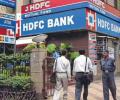
The merged entity's deposits grew by 16.2 per cent YoY at Rs 20.63 trillion at the end of the first quarter. Sequentially, the merged entity's advances rose by about 0.7 per cent to Rs 22.30 trillion as of March 31, 2023. However, the pace of deposit mobilisation was higher at 1.2 per cent over Rs 20.39 trillion as of March 31, 2023.

To provide more choices to customers, the Reserve Bank of India has suggested mandating bank and non-bank card issuers to issue debt, credit and prepaid cards on more than one network. Customers can choose any one either at the time of issue of the card or anytime later, according to draft norms released by the Reserve Bank of India on Wednesday. The RBI said card issuers would also be barred from signing agreements that limit their ability to tie-up with other card-networks, according to the draft.

Reflecting strong momentum in business, commercial banks, including one public sector lender, reported a year-on-year (YoY) growth in advances. This was higher than or around the banking sector trend in the first quarter ended June 2023. Bank of Maharashtra said its loans expanded by 25 per cent YoY to Rs 1.75 trillion. This pace was much higher than the banking system's 15.4 per cent growth till June 16, 2023, according to Reserve Bank of India (RBI) data.

The pace of lending to the infrastructure sector, including power and roads, fell sharply to 1.8 per cent year-on-year (YoY) in May, 2023 compared to 9.8 per cent in May, 2022. Within the segment, the growth in loans to the power sector was at 0.3 per cent YoY in May 2023, down from 9.3 per cent in May 2022. The RBI data showed that outstanding credit to power sector stood at Rs 6.17 trillion in May.

The sharp rally in the broader markets has propelled India's market capitalisation (m-cap) to a new high. The combined m-cap of all BSE-listed firms rose to Rs 291.9 trillion in intraday trade on Thursday before settling lower at Rs 290.9 trillion. The previous record was on December 14, 2022, at Rs 291.3 trillion.

Corporate India's net profit as a percentage of gross domestic product (GDP) dipped in the 2022-23 financial year (FY23) -- after rebounding sharply in FY22 -- amid a decline in global commodity prices. Top 500 companies' combined net profit stood at 4.1 per cent of the GDP for FY23, down from 4.3 per cent in the previous financial year when it had gone up from just 3.5 per cent in FY21. "The year-on-year (YoY) decline was led by global commodities, which contributed adversely to the ratio, while the financial sector contributed positively.

Half of India's top-priced stocks have outperformed the benchmark indices this year. On a year-to-date basis (YTD), the Sensex has gained 3.8 per cent and the Nifty50 3.4 per cent. The stocks which have outperformed the indices include 3M India, Nestle India, MRF, Shree Cement and Bosch while those who have underperformed the benchmarks include Page Industries (-10.4 per cent), Procter & Gamble (-4 per cent), Honeywell Automation (-0.9) and Lakshmi Machine Works, which gained 1.3 per cent.

The initial public offering (IPO) market has seen some momentum of late with robust responses to recent issues. However, only some have been able to ride the wave. So far in 2023, 23 companies have let their approval granted by the markets regulator - the Securities and Exchange Board of India (Sebi) - lapse.
Foreign portfolio investors (FPI) flows have turned positive on a trailing 12-month (TTM) basis for the first time since December 2021. Thanks to robust inflows over the past three months, the TTM overseas flows into domestic equities stand at over $7.3 billion-the most since November 2021. This has helped propel one-year Nifty returns to 12 per cent.

Bank of Baroda (BoB) has made prudential provision of Rs 500 crore for exposure to Go First, which has sought bankruptcy protection after the National Company Law Tribunal (NCLT) admitted its plea for voluntary insolvency. Sanjiv Chadha, managing director and chief executive officer of BoB, said the bank identifies issues in advance and makes provisions if required. The Mumbai-based public sector lender has an exposure of Rs 1,300 crore to the troubled airline.

Brokers have requested for a three-month extension from the Securities and Exchange Board of India (Sebi) for the validation of Know Your Client (KYC) records. In a letter to Sebi, industry body -- Association of National Exchanges Members of India (Anmi) -- has cited various issues and concerns raised by its members that have hampered the smooth completion of the validation process within the stipulated timeline. The Sebi circular had given KYC Registration Agencies (KRAs) a timeline of 180 days, ending on April 30, 2023, to validate client KYCs.

The ownership by domestic investors, individual as well as institutional, in companies listed on the National Stock Exchange (NSE) has breached the 25 per cent mark for the first time. The share stood at 25.72 per cent at the end of the March 2023 quarter, up from 24.44 per cent in the previous quarter, according to data from Prime Database. The share of foreign portfolio investors (FPIs), meanwhile, rose slightly to 20.56 per cent from 20.24 per cent as on December 31, 2022.
 © 2026 Rediff.com - Advertise with us - Disclaimer - Privacy Policy - Sitemap - Feedback - About us - Terms of use - Grievances